Eye care service
Contact Lens Exams & Fittings in Park Slope
Help finding contact lenses that fit, feel comfortable, and meet your vision needs, including routine and more complex fittings.
Contact lens care with clear answers.
Comfort problems, blurry vision, or a previous unsuccessful fitting deserve a closer look. We work with you to choose an appropriate lens and assess how it fits, feels, and helps you see.
A patient’s perspective
“Dr. Lin was extremely knowledgeable and helpful during my contact lens fitting. He had clear responses to all of my questions and I felt very taken care of.”
On this page
Reviewed for clinical accuracy by Justin Bazan, OD.
At a glance
What we can help with
Contact-lens care ranges from straightforward renewals to more individualized specialty fittings.
-
Routine + complex prescriptions
We fit common prescriptions as well as astigmatism, near-vision needs, high or unusual prescriptions, comfort problems, and prior unsuccessful fittings.
-
Specialty lens options
Scleral and corneal GP/RGP lenses are available when conventional soft lenses are not the best fit for vision, corneal shape, or comfort.
-
Thousands of trial lenses
We keep broad in-office fitting sets so we can often try multiple powers and designs without waiting for every diagnostic lens to be ordered.
-
Recent eye exam first
A recent comprehensive eye exam is required before fitting so the doctor has current prescription and eye-health information.
A recent comprehensive eye exam comes first
A contact lens fitting requires a recent comprehensive eye exam so the doctor has current information about both your prescription and your eye health. If you had a comprehensive eye exam elsewhere within the last 3 months, we can generally use that exam as long as we receive a copy of the complete exam record.
An eyeglass prescription by itself is not enough. If we do not have documentation of the recent comprehensive exam, we will need to perform a comprehensive eye exam before proceeding with the contact lens fitting.
The contact lens fitting is a separate service from the comprehensive exam because it involves contact-lens-specific measurements, lens selection, fit assessment, vision evaluation, and follow-up.
See exactly what a contact lens exam adds beyond a comprehensive eye exam.
What a fitting can involve
The fitting process depends on the lens and your eyes. It may involve additional measurements, diagnostic or trial lenses, assessment of vision and lens fit, and follow-up before the prescription is finalized.
For most patients paying for the fitting themselves, the fitting/follow-up period is generally 90 days. When vision-plan benefits are being used, follow-up follows the applicable plan guidelines.
Some routine questions or minor adjustments can be handled by email. If the doctor needs to reassess the lens on your eye, we will let you know that an in-office visit is needed.
Vision-plan benefits often reduce contact-lens costs
Park Slope Eye is in network with VSP, EyeMed, UFT. Depending on the specific plan and lens type, vision benefits may cover or reduce the cost of the contact lens evaluation or fitting and may also provide benefits toward contact lenses.
When medical eye care is also involved, medical insurance may apply to eligible medical services according to your plan.
Contacts haven't worked for you before? That doesn't necessarily mean they can't.
Contact lenses are one of Park Slope Eye's particular areas of interest. We routinely work with straightforward prescriptions, but we especially enjoy helping patients with astigmatism, near-vision needs, high or unusual prescriptions, comfort problems, irregular corneas, or previous contact lens fittings that did not work well.
Contact-lens materials, designs, and prescription options continue to evolve. Our longstanding involvement in the contact-lens profession and relationships across the industry help us stay close to new lens developments, and we often gain early hands-on experience with newly released contact-lens designs. That can give us more current options to consider when we are trying to improve vision, comfort, stability, or ease of wear. Our manufacturer relationships expand the options available to our patients; they do not determine which lens we recommend. The goal is to find the lens that works best for your eyes and your life.
Different lens designs solve different problems. Toric lenses are designed for astigmatism; multifocal or monovision approaches can help patients who need both distance and near vision; scleral and corneal GP/RGP (gas-permeable or rigid gas-permeable) lenses can be useful when standard soft lenses do not provide the vision, fit, or comfort a patient needs; and Ortho-K lenses are worn overnight and may be used as part of a myopia-management program for appropriate patients.
Thousands of trial lenses—and time to try them
Park Slope Eye keeps thousands of individual contact-lens trial lenses in the office, including broad and full fitting sets across major lens families.
Because so many trial powers and designs are physically available in the office, we can often fit even high or complicated prescriptions the same day rather than ordering every trial lens one at a time.
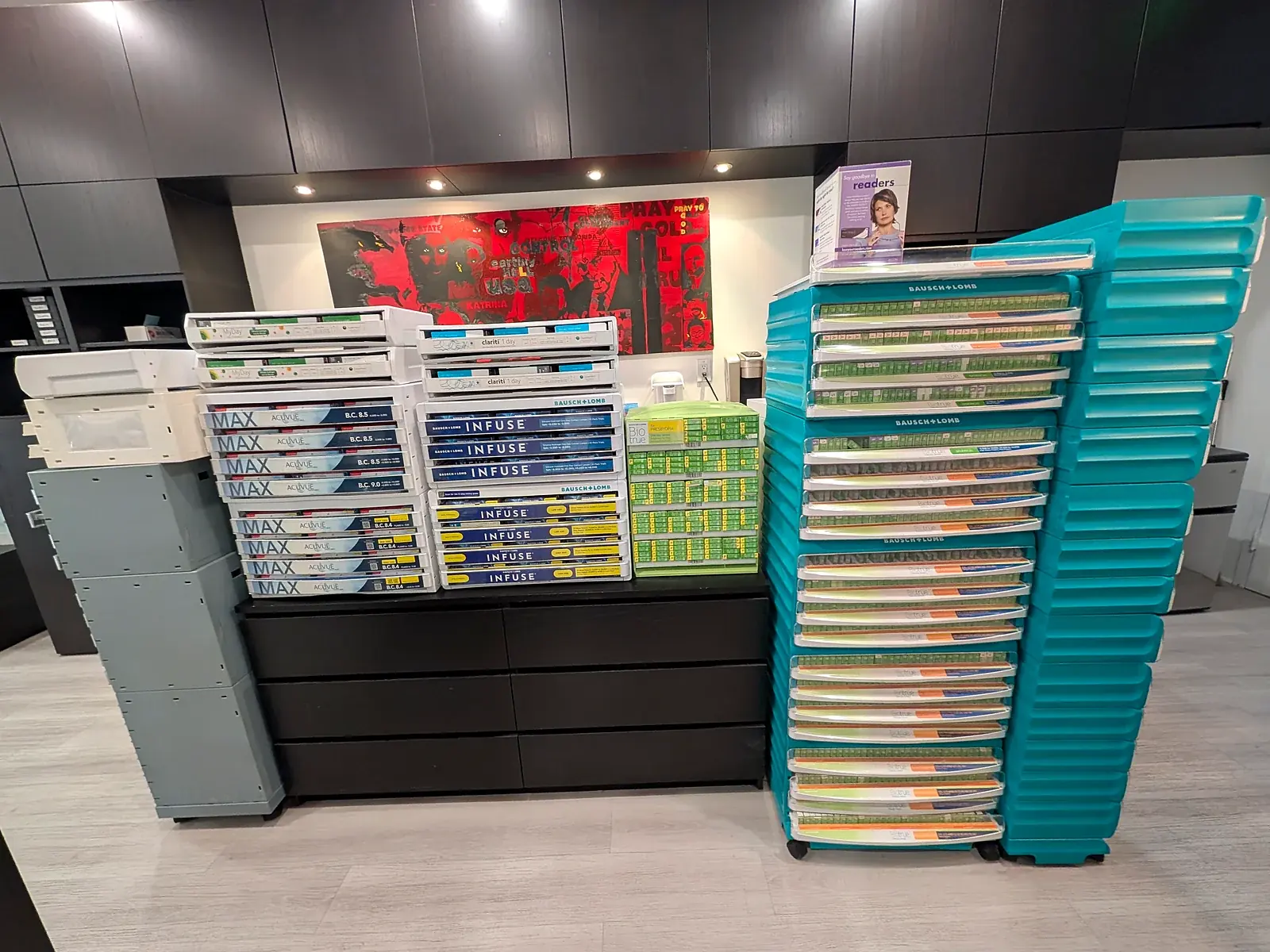
Our in-office trial inventory includes major lens families from Alcon, Bausch + Lomb, CooperVision, Johnson & Johnson / Acuvue, NaturalVue.
When the exact trial lens we need is not already here, we can usually order it quickly. One reason we keep so many trial options available is simple: when one lens is not working, we want to have another thoughtful option to try.
That breadth matters most when it is combined with careful fitting, experience, persistence, and listening to what the patient actually needs from their lenses.
Trial lenses are provided generously when they are useful to the fitting process. We want patients to have a fair opportunity to experience how a lens actually sees and feels in real life before the prescription is finalized.
When clinically appropriate and when the correct trial lens is available, we can also often provide complimentary temporary trial lenses to help bridge a short gap while a patient is waiting for an ordered supply or an upcoming appointment.
For routine soft lenses, daily disposables are usually our first choice
Contact lens manufacturers have continued to expand their daily disposable options, including more prescriptions and lens designs than were available in the past. That means many patients who previously could not wear a daily disposable lens may now have one available to them. When an appropriate daily disposable option is available, it is generally our first choice for routine soft contact lens wear because of the benefits of starting each day with a fresh lens, including convenience, comfort, and eye health. There is no lens case to maintain and no overnight cleaning routine.
Some prescriptions, specialty-lens needs, or myopia-management plans still require a different lens design or replacement schedule, and we choose the option that best fits the individual patient.
What does a successful contact-lens fit mean to us?
We do not judge a contact-lens fit by visual acuity alone. A successful fit should work in the patient’s real life, not just for a few minutes in the exam room.
- clear, stable vision for the tasks that matter to you
- comfort across a realistic wearing day
- healthy wear and an appropriate fit on the eye
- a practical insertion, removal, and care routine
- a replacement schedule and overall plan you can realistically maintain
Hard-to-fit and specialty contact lenses
Scleral and corneal GP/RGP lenses can be useful when conventional soft lenses are not the best fit for a patient's prescription, corneal shape, vision needs, or comfort. A specialty lens fitting usually requires more individualized measurements and follow-up than a routine soft-lens fit.
Contact lenses for children
There is no single minimum age that determines whether every child is ready for contact lenses. Maturity, hygiene, motivation, prescription, eye health, and family support all matter.
Is my child ready for contact lenses? Read our parent guide.
Myopia management and Ortho-K
Ortho-K and NaturalVue daily contact lenses are among Park Slope Eye’s myopia-management options for appropriate patients. Our broader program also includes Stellest glasses and low-dose atropine. The choice depends on the individual patient.
Explore our myopia-management options.
Your prescription is yours, and we'd love a chance to quote your contact lenses
When your fitting is complete, we provide your contact lens prescription. You do not have to purchase contact lenses from Park Slope Eye to receive it, and there is no pressure to order from us.
That said, we hope you’ll give us a chance to provide a contact-lens price quote before you order elsewhere. We work hard to keep our pricing competitive, and manufacturer rebates and vision-plan benefits can often make ordering through us an excellent value. There is no obligation to purchase from us, but choosing Park Slope Eye also supports an independent local practice.
Reordering, shipping, and manufacturer rebates
Current patients can reorder by email. There is no need to call for a routine contact-lens reorder. Email Info@ParkSlopeEye.com and we can use the contact lens information we have on file, confirm the order, and send a secure payment link when appropriate.
Annual supplies receive free direct-to-patient shipping. Other office and direct-to-patient shipping options are also available. For current shipping charges and ordering details, see Insurance, Fees & FAQs.
Annual supplies also often qualify for strong manufacturer rebates. Park Slope Eye provides applicable rebate instructions, information, and invoices.
Ready to schedule?
Questions before you book? Email us at Info@ParkSlopeEye.com.